
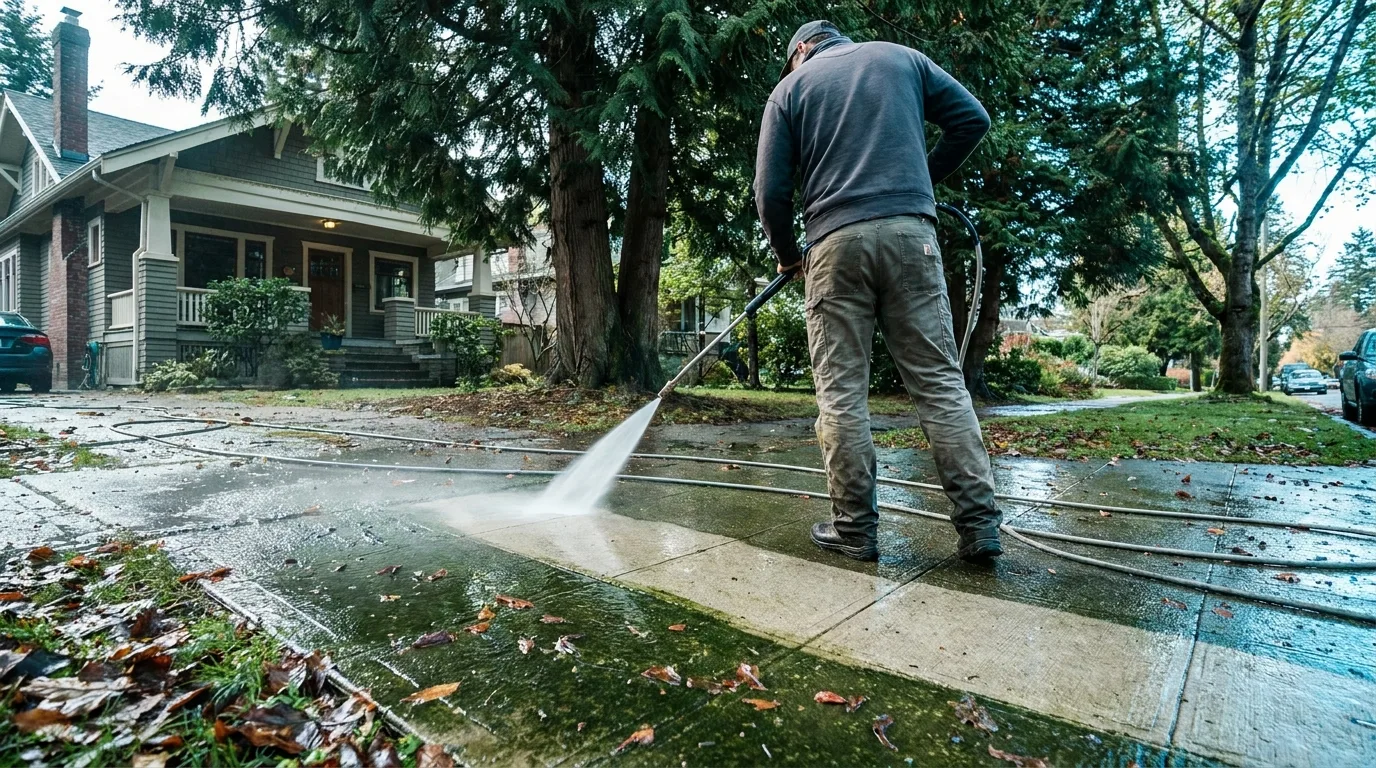
Safer Walkways and Frontages
Algae on a shaded path is genuinely slippery once the rain starts, and a fall on your frontage becomes your problem. We put the traction back before winter does the testing.
Wet algae on a smooth path is close to ice. Anyone who has stepped onto a shaded walkway on a wet October morning knows the feeling — the moment where your foot keeps moving after you expected it to stop. It is not an exaggeration and it is not rare. Slips on wet, algae-covered pedestrian surfaces cause a serious number of injuries every year, and they are concentrated in exactly the climate we live in.
The path from the street to your front door, the side passage down to the back garden, the steps at the entry, the walkway around a strata building, the stretch of pavement outside a small shop: all of these are surfaces people walk on in the dark, in the rain, carrying things, with their hands full.
Why it happens here
Growth needs moisture and shade, and mid-Island walkways offer plenty of both. Paths tucked between a house and a fence line, walkways shaded by mature firs and cedars, north-facing entries that never catch direct sun, and the sections under overhanging eaves that stay damp for weeks — those are where the film is thickest.
Low footfall makes it worse. Frequently used paths get scuffed clear by boots. The side path, the back gate route, the seldom-used steps down to the garden shed: those are the ones that get genuinely dangerous, and they are the ones people notice only after somebody slips on them.
Liability, plainly put
If someone falls on the walkway at your property, that is your problem before it is anyone else's. For homeowners it is an insurance conversation you do not want to have. For a strata, common-area footing is a stated responsibility of the corporation, and a known, visible, untreated hazard is a bad position to defend. For a small business, the frontage your customers walk in on is part of your premises in every practical sense.
Preventive cleaning is the cheap end of this problem. It is not a complicated calculation.
What we clean
Front and side walkways, garden paths, entry steps and landings, porches and stoops, side passages and back gate routes, wheelchair ramps and accessible approaches, strata common paths and shared entries, apartment and townhouse walkways, and small commercial frontages and courtyard seating areas.
Surface types vary and we handle them differently. Poured concrete paths take a straightforward clean. Interlocking paver walkways need care with the joint sand, which usually wants topping up afterwards. Flagstone and slate are worked more gently, since the pieces can shift. Brick paths hold growth in the joints and need the joints worked, not just the faces. Wooden walkway boards and ramps get low pressure so they are not roughened, since a splintery ramp is its own hazard.
Traction, not just appearance
The measure of this job is grip. We work the surface until the biological film is gone, including the parts that look fine from a distance but feel slick underfoot, and we pay attention to the edges, the step nosings and the transitions between surfaces — the exact points where footing changes and people go over.
Steps get the most attention. A slip on a flat path is embarrassing. A slip on wet steps is an injury.
Strata and commercial work
We handle strata common areas and small commercial frontages alongside residential work, Monday to Friday between 9:00 AM and 5:00 PM. We can plan around your quieter periods within those hours, cone and manage the working area so people are routed safely past it, and work in sections so a walkway is never entirely out of use. For stratas we can quote a whole common-area path network as one job, which is usually far better value than doing it piecemeal.
Timing
Autumn is the natural time — clearing the summer's growth before the wet months arrive is when it does the most good. Spring is the other good window, taking off what built up over winter. Deeply shaded paths under trees often need both.
A walkway is also the cheapest thing on this list to keep on top of. It is a small surface compared with a roof or a driveway, it cleans quickly, and the consequence of neglecting it is the one consequence on this whole site that involves somebody getting hurt. If you only do one preventive job before winter, this is a strong candidate.
We clean walkways across Nanaimo, Lantzville, Nanoose Bay, Cedar, Parksville, Qualicum Beach, Ladysmith, Chemainus, Errington and Coombs, Monday to Friday, 9:00 AM to 5:00 PM. Quotes are free.
This is a safety job first and a cosmetic one second — we prioritise the shaded, low-traffic stretches where the film is thickest and the footing is worst, not just the parts that look bad from the street.
What You Get From Sidewalk Cleaning
Slippery algae film removed and traction restored before the wet months
Shaded, low-traffic stretches prioritised — where the footing is worst
Step nosings, landings and surface transitions given extra attention
Reduced slip risk on the frontage you are responsible for
Strata common paths and shared entries quoted as one job
Small commercial frontages and courtyard areas covered
Correct handling for concrete, pavers, flagstone, brick and timber
Work staged in sections so a walkway is never fully out of use
Aimed at grip on the route people actually walk
Steps, treads and landings detailed by hand
Growth treated rather than surface-rinsed, so it stays off longer
Edges cleared where moss dams water onto the path
What Sidewalk Cleaning Covers
Walkways are the surface everyone actually touches. A path to a front door, a set of steps, a shared route through a townhouse complex — these are narrow, often shaded, and they collect a black algae film that is genuinely slippery wet. Unlike a driveway, where a slick patch is inconvenient, a walkway is where people carry things, arrive in the dark, and use handrails. Cleaning one is a safety job that happens to look better afterwards.
How Sidewalk Cleaning Works
Walk the route
We go over the paths as a pedestrian would, noting where the film is heaviest, where it stays shaded and where the footing already feels unreliable.
Plan access
For shared or public-facing walkways we work out sections, routing and coning so people can get past safely while a stretch is being cleaned.
Treat the growth
A cleaning solution is applied to break down the biological film, with dwell time so the removal is thorough rather than surface deep.
Clean for traction
The walking surface is cleaned in even overlapping passes, with steps, nosings, edges and transitions detailed by hand.
Check the footing
We rinse everything down, top up paver joint sand where needed, and walk the finished route to confirm the grip is back.
The Method, in Short
Walk the route the way a visitor does
From the street to the door, including the steps, the landing and the threshold. The slick section is usually a specific stretch rather than the whole path — often where a hedge or a fence cuts the light.
Treat the film at the source
The black surface film is biological growth, so it is treated rather than scrubbed. Pressure alone lifts the top and leaves the rest to darken again quickly.
Clean evenly, including the step treads
Even passes across the walking surface, with treads, nosings and the base of any handrail done by hand — the places a surface cleaner physically cannot reach.
Check the edges and the drainage
Where a path meets grass, a bed or a wall, moss builds a lip that holds water on the walking surface. Clearing it is often what stops the film coming straight back.
What It Costs
Priced by the length of path and the number of steps, since treads and landings are hand work rather than machine work. Quotes are free.
Sidewalk Cleaning by town
Tree cover, exposure and housing age change what this job actually takes. These cover it town by town.
Book Your Sidewalk Cleaning
Tell us about the job and we'll send you a free, no-obligation quote for sidewalk cleaning.
Sidewalk Cleaning Questions
Yes. A wet biological film on a smooth path removes most of your traction, and it is the reason so many falls happen on paths that look perfectly ordinary. The shaded, less-used stretches are usually the worst, because nothing wears the growth back.
We do. Strata common paths, shared entries, townhouse walkways and small commercial frontages all get done alongside our residential work. For a strata we will usually quote the whole path network at once, which works out better than tackling it section by section.
We work Monday to Friday, 9:00 AM to 5:00 PM, so we cannot do overnight or weekend work. What we can do is schedule for your quieter part of the day and work in sections, keeping a safe route open the whole time.
Not with the right approach. Pavers get worked so the joint sand is disturbed as little as possible and topped up afterwards, and flagstone is cleaned more gently because individual pieces can shift. We tell you at the quote if a path has loose or lifting sections that should be reset first.
Usually because it gets less sun and less air. Paths run beside hedges, fences and house walls, they are narrow, and they often sit on the shaded side, so they stay damp far longer after rain. That is exactly the condition the black algae film needs. The driveway is wide and open, dries between showers, and grows a fraction as much.
It is genuinely slippery once wet, and it is the reason for most falls on residential paths. Dry, it grips fine and simply looks dark, which is why it gets ignored — the risk only appears in the conditions where nobody is testing it. On steps, where a slip has somewhere to go, it is worth treating as a maintenance item rather than a cosmetic one.
Yes, and shared walkways are usually in worse condition than private ones for a simple reason: nobody in particular owns them, so nobody gets to them until there is a complaint. Long runs between units are also often the most shaded ground on the property. They are priced by total length rather than per unit.
You Might Also Need
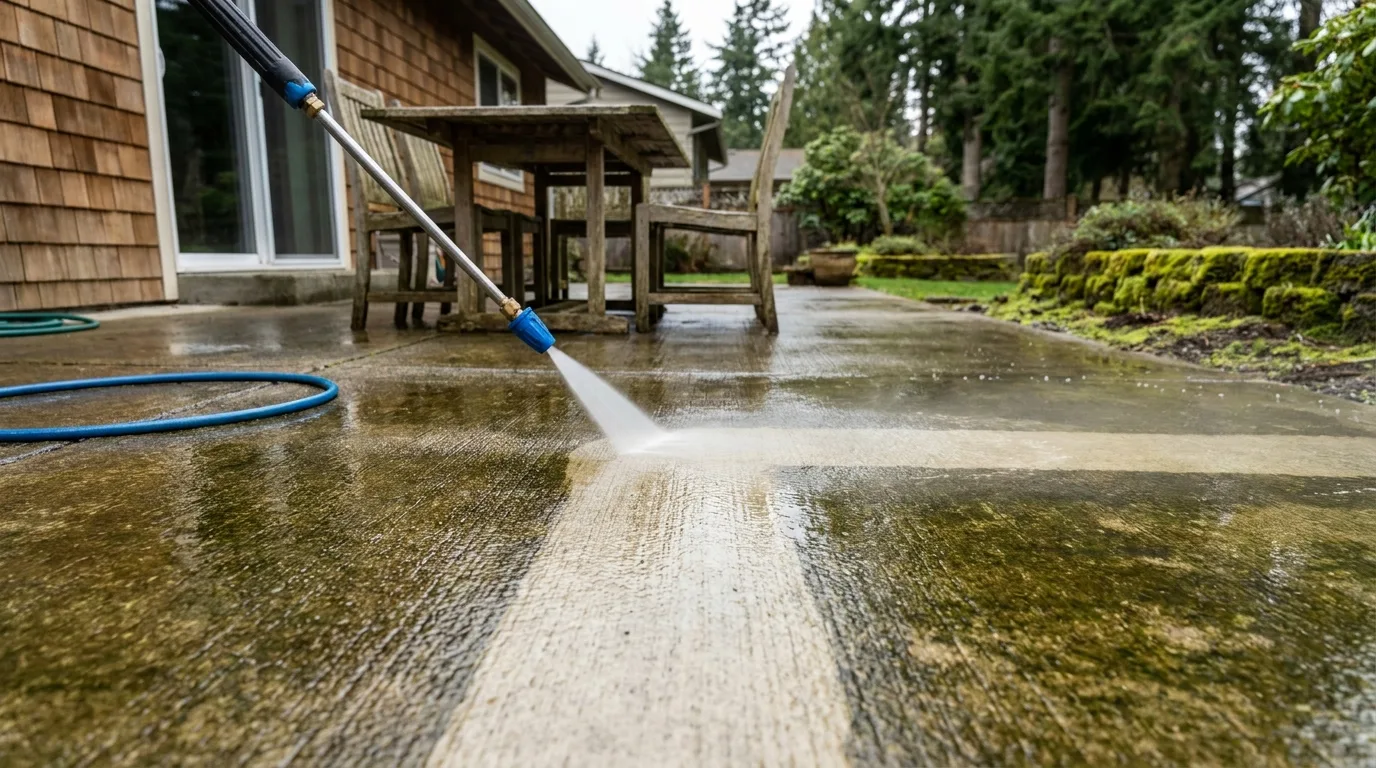
Concrete Cleaning
Cleaning for concrete anywhere on your property — patios, pool surrounds, garage floors, stairs, retaining walls, exposed aggregate and stamped finishes.
Learn more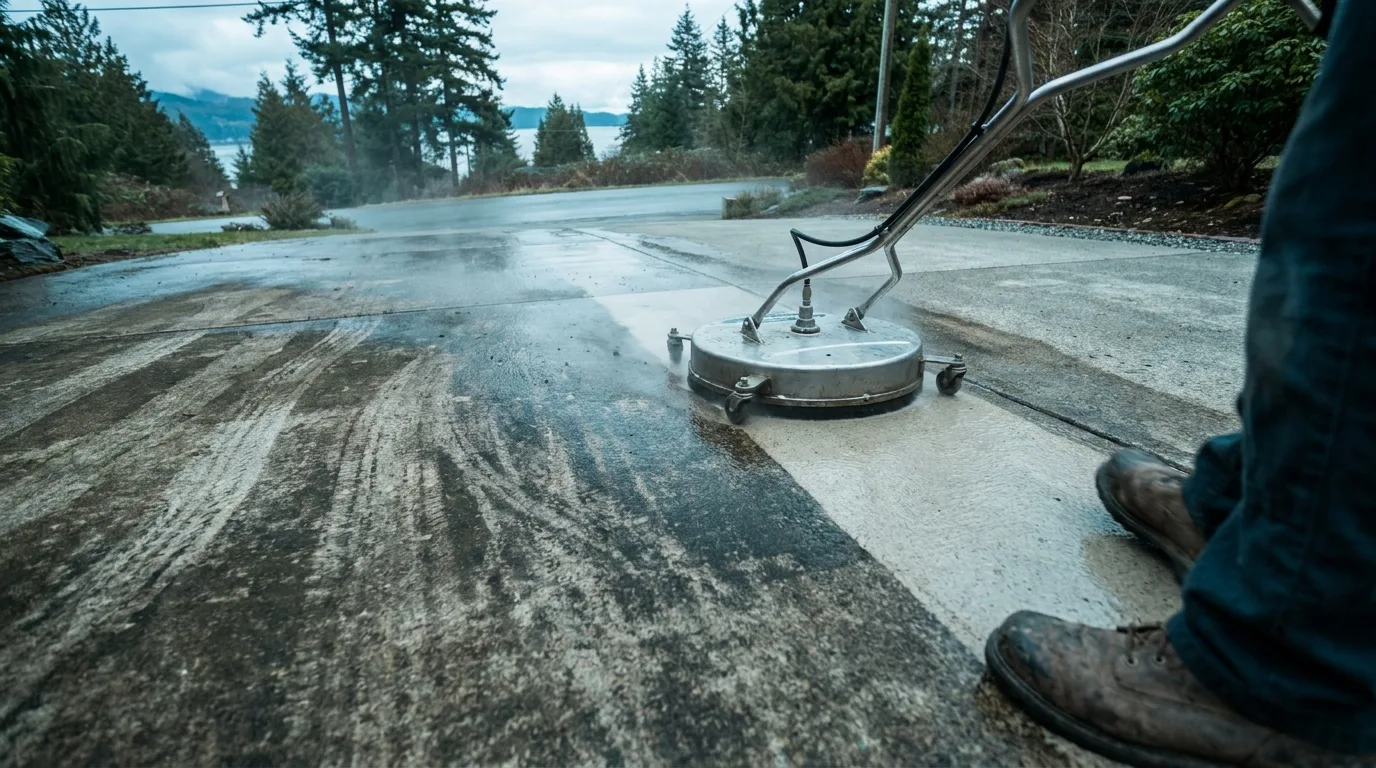
Driveway Cleaning
Deep cleaning of driveways and parking aprons, targeting vehicle staining — oil and fluid drips, tire scuffs, rust marks and the algae strip down the centre.
Learn more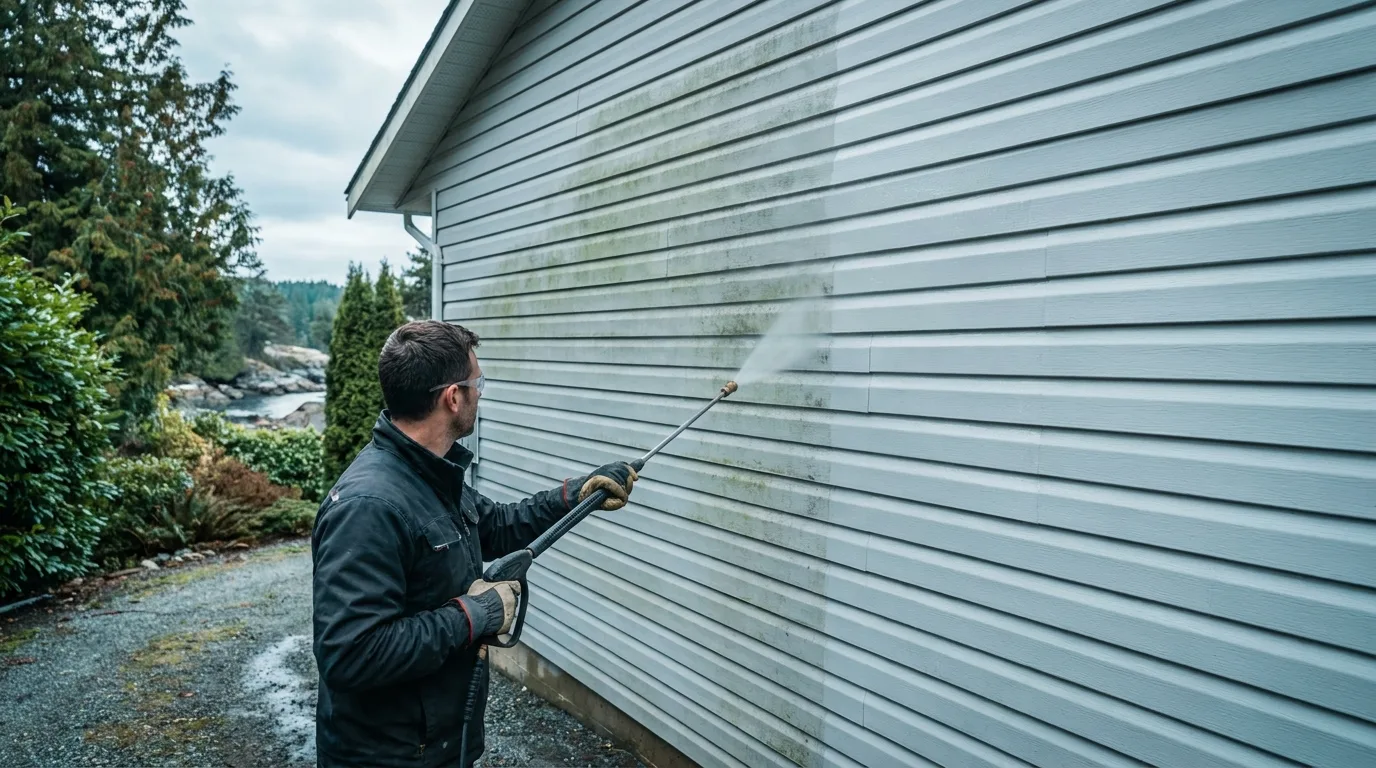
House Washing
A full soft wash of your home's exterior walls, soffits, fascia and trim, lifting algae, mildew, cobwebs and road film without forcing water behind the cladding.
Learn moreNo Charge for Asking
We quote sidewalk cleaning for free, and you get the number before anything is booked.